
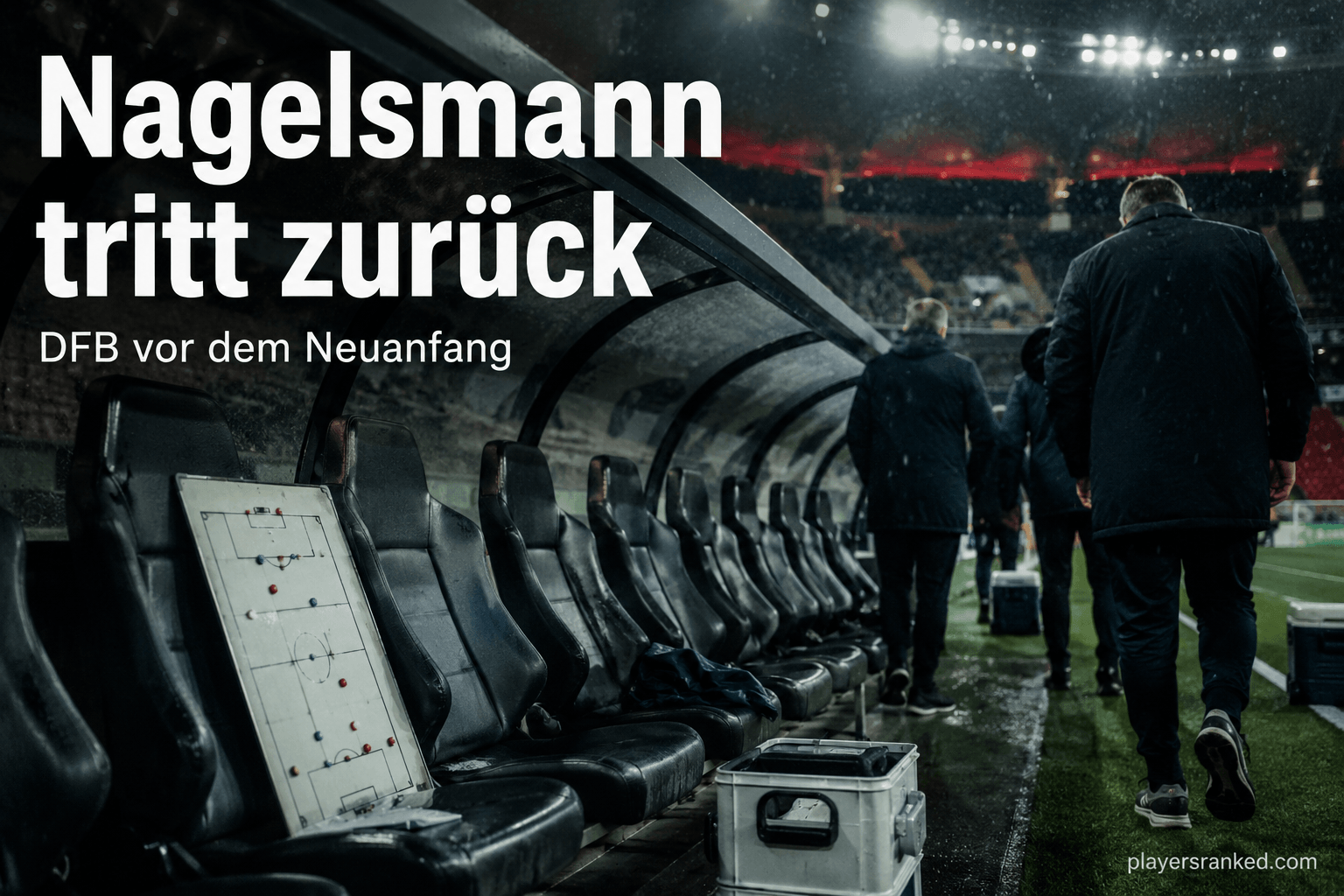

🔴 LIVE UPDATE: July 3, 2026, 11:00 AM (CEST)
According to consistent reports from Sky Germany, Bild and Sportschau/SWR, Julian Nagelsmann has resigned as head coach of the Germany national football team. At the time of publication, the German Football Association (DFB) had not yet issued an official statement. The DFB Supervisory Board and Shareholders’ Assembly have been meeting in Frankfurt since 11:00 AM to discuss the consequences of Germany’s disappointing FIFA World Cup 2026 campaign.
This article will be updated as more official information becomes available.
Key Takeaways
| Topic | Current Status |
|---|---|
| Germany head coach | Julian Nagelsmann has reportedly resigned |
| Official DFB confirmation | Pending |
| Reason | FIFA World Cup 2026 Round of 32 elimination against Paraguay |
| DFB meeting | Ongoing since 11:00 AM |
| Leading replacement candidate | Jürgen Klopp |
| Nagelsmann’s contract | Originally valid until UEFA Euro 2028 |
| Other key decisions | Futures of Rudi Völler and Andreas Rettig remain uncertain |
The Story in 30 Seconds
The German Football Association (DFB) is facing one of the biggest sporting crises in its recent history. Following Germany’s shock Round of 32 elimination against Paraguay at the 2026 FIFA World Cup, speculation over Julian Nagelsmann’s future intensified rapidly. On July 3, several major German media outlets reported that the 38-year-old had decided to resign as Germany’s head coach. While the DFB leadership discusses the next steps, attention has already shifted to his successor, with Jürgen Klopp widely regarded as the leading candidate despite his existing contract with Red Bull.
Germany in Crisis: World Cup Exit Triggers Major Changes
Germany’s defeat against Paraguay represents far more than a disappointing tournament exit. For the German Football Association, it marks another historic setback.
Germany has now failed to meet expectations at three consecutive FIFA World Cups, following group-stage elimination in 2018, a Round of 16 exit in 2022 and another early knockout in 2026.
Within hours of the defeat, public debate shifted from analysing the match itself to questioning the overall direction of German football. Not only Julian Nagelsmann came under increasing pressure, but also sporting director Rudi Völler and DFB managing director Andreas Rettig.
Although Nagelsmann firmly ruled out resigning immediately after the match, events behind the scenes appear to have changed the situation dramatically over the following days.
Timeline of Germany’s Coaching Crisis
June 29, 2026 – Germany Eliminated by Paraguay
Germany’s World Cup campaign came to an unexpected end at Gillette Stadium in Foxborough, Massachusetts.
After a 1-1 draw following extra time, Germany lost the penalty shootout 4-3. Much of the post-match discussion centred on a disallowed German goal during extra time.
After the match, Julian Nagelsmann addressed the media.
Julian Nagelsmann
“I’m not someone who walks away. That’s out of the question.”
At that stage, most observers expected him to remain in charge.
June 30 – July 1: Silence After Returning Home
Following Germany’s return from the United States, Nagelsmann arrived in Munich but left the airport without making any public comments.
Meanwhile, DFB president Bernd Neuendorf released an official statement acknowledging the disappointment. However, he stopped short of offering explicit support for the national team coach.
At the same time, several German media outlets reported that Nagelsmann had effectively lost the backing of key decision-makers within the federation.
According to those reports, discussions were no longer focused on whether he would remain in charge, but on the financial conditions of a possible separation.
Public perception changed significantly within just a few hours.
July 2 – Crisis Meeting in Frankfurt
On Thursday, senior DFB officials held a lengthy crisis meeting at the federation’s headquarters in Frankfurt.
Those in attendance reportedly included:
- DFB President Bernd Neuendorf
- Sporting Director Rudi Völler
- DFL Supervisory Board Chairman Hans-Joachim Watzke
- Managing Director Andreas Rettig
- Germany head coach Julian Nagelsmann
After several hours, Nagelsmann left the meeting without speaking to the media.
The DFB also declined to comment publicly.
However, multiple reports suggested that senior officials had encouraged the coach to consider stepping down voluntarily.
July 3 – Nagelsmann Reportedly Resigns
On Friday morning, Sky Germany, Bild and Sportschau/SWR all reported that Julian Nagelsmann had decided to resign.
Since 11:00 AM, the DFB Supervisory Board and Shareholders’ Assembly have been meeting to discuss the federation’s next steps.
Alongside the search for a new head coach, the future of several senior DFB officials is also expected to be discussed.
At the time of writing, an official DFB statement had not yet been released.
Why Would the DFB Prefer a Voluntary Resignation?
Financial considerations are believed to be almost as important as the sporting situation.
Nagelsmann remains under contract until UEFA Euro 2028.
According to media estimates, his annual salary is worth up to €8 million.
Financial Overview
| Item | Estimated Value |
|---|---|
| Contract length | Until UEFA Euro 2028 |
| Annual salary | Up to €8 million |
| Remaining contractual cost | Approximately €14 million |
| DFB’s preferred outcome | Mutual agreement |
Dismissing Nagelsmann outright would likely have resulted in significant compensation costs.
For that reason, an amicable agreement had reportedly been viewed as the most realistic outcome for several days.
According to multiple reports, both parties have discussed a financial settlement well below the remaining value of his contract.
Such an agreement would allow the DFB to minimise costs while focusing resources on rebuilding the national team.
Why Germany’s World Cup Exit Matters So Much
Germany’s defeat against Paraguay is only part of a much bigger story.
Instead, it represents the latest chapter in a prolonged decline that has unfolded over several major tournaments.
Three World Cups, Three Disappointments
| Tournament | Result |
|---|---|
| FIFA World Cup 2018 | Group Stage Exit |
| FIFA World Cup 2022 | Round of 16 Exit |
| FIFA World Cup 2026 | Round of 32 Exit |
Within just eight years, Germany has fallen well short of expectations at three consecutive World Cups.
For a nation traditionally regarded as one of international football’s strongest teams, this represents one of the most difficult periods in the modern history of the national team.
As a result, the debate now extends far beyond the head coach. Germany’s player development, squad planning, leadership structure and long-term football strategy are all expected to come under close review in the coming weeks.
Who Will Be Germany’s Next Head Coach? The Leading Candidates
With Julian Nagelsmann expected to step down, attention has immediately shifted to who will become the next Germany national team head coach.
Although the German Football Association (DFB) has not officially announced any candidates, media coverage over the past few days paints a clear picture. The same names appear across multiple reports, with differences mainly relating to how likely each appointment is.
Leading Candidates at a Glance
| Candidate | Probability | Availability | Biggest Obstacle |
|---|---|---|---|
| Jürgen Klopp | ⭐⭐⭐⭐⭐ (approx. 65%) | Under contract with Red Bull | Contract release & salary |
| Christian Streich | ⭐⭐⭐ (approx. 15%) | Immediately available | Personal willingness |
| Ralf Rangnick | ⭐⭐ (approx. 8%) | Under contract with Austria | Contract termination |
| Thomas Tuchel | ⭐ (approx. 5%) | England head coach | Not available in the short term |
| Sandro Wagner | ⭐ (approx. 4%) | Immediately available | Limited head coaching experience |
| Other candidates | ⭐ (approx. 3%) | Unknown | Surprise appointment |
Jürgen Klopp Is the Clear Favourite
If the DFB is looking for a genuine fresh start, Jürgen Klopp is widely regarded as the leading candidate.
The former Borussia Dortmund and Liverpool manager has emerged as the overwhelming favourite in both German media and expert opinion since Germany’s World Cup exit.
Klopp combines elite-level success with exceptional leadership qualities. Few German coaches enjoy a stronger reputation both domestically and internationally.
Why Klopp Would Be an Ideal Fit
- Multiple Bundesliga titles
- UEFA Champions League winner
- Premier League winner
- Extensive experience at the highest level of European football
- Outstanding reputation for developing teams
- Strong support from players and supporters
- Global recognition and leadership credentials
Following several disappointing tournaments, Klopp could provide exactly what many believe Germany has been missing: credibility, energy and a clear footballing identity.
Current Situation
Since early 2025, Klopp has served as Head of Global Soccer for Red Bull.
According to reports, his contract runs until 2029.
He is also working as a television analyst during the 2026 FIFA World Cup.
When asked about the Germany job, Klopp has deliberately avoided making any firm commitments.
“I haven’t thought about it yet. Of course I understand why my name is being mentioned.”
It was neither a confirmation nor a rejection.
Why Klopp Is the Favourite
✅ Outstanding international reputation
✅ Proven success under pressure
✅ Elite man-management skills
✅ One of Germany’s most respected football figures
✅ Symbolises a genuine fresh start
Potential Obstacles
❌ Long-term contract with Red Bull
❌ Likely to command a very high salary
❌ Possible compensation payment
❌ No publicly known release clause
Despite these challenges, Klopp remains the clear frontrunner.
Christian Streich Would Be the Emotional Choice
Few German coaches are as widely respected as Christian Streich.
Over more than two decades at SC Freiburg, he transformed the club into one of the Bundesliga’s most admired success stories.
Following his retirement from coaching, Streich has worked as a television pundit, but many supporters would welcome his return to the touchline.
Why Streich Appeals to Many Fans
After several disappointing tournaments, many supporters want a coach who represents humility, unity and authenticity.
Those qualities have defined Streich throughout his career.
His greatest strength lies not only in tactics, but in his ability to build strong team cultures and earn the trust of players.
Following a period of declining confidence around the national team, those leadership qualities could prove invaluable.
Advantages
- Immediately available
- Highly respected throughout German football
- Outstanding leadership skills
- Strong public support
- No transfer compensation required
Disadvantages
- No previous international coaching experience
- No experience managing one of Europe’s biggest clubs
- Unclear whether he would be interested in the role
Ralf Rangnick Offers Extensive International Experience
Ralf Rangnick has long been regarded as one of Germany’s most influential football thinkers.
His tactical philosophy helped shape modern pressing football and has inspired an entire generation of coaches.
As Austria’s national team manager, he has also demonstrated his ability to transform an international side within a relatively short period.
Why Rangnick Is a Strong Candidate
- Exceptional tactical expertise
- Extensive international experience
- Proven success with national teams
- Clear playing philosophy from day one
Why a Move Would Be Difficult
Rangnick remains under contract with the Austrian Football Association.
Austria’s own World Cup campaign also ended in disappointment, making an immediate departure increasingly complicated.
For that reason, a quick appointment currently appears unlikely.
Thomas Tuchel Remains an Outside Candidate
From a purely sporting perspective, Thomas Tuchel is among Germany’s most accomplished modern coaches.
His résumé includes a UEFA Champions League title, multiple domestic honours and successful spells at several of Europe’s biggest clubs.
However, his appointment currently appears unrealistic.
Tuchel remains under contract as England’s national team manager, making a return to Germany highly unlikely in the near future.
Sandro Wagner Could Be an Interim Solution
If negotiations with a long-term candidate take longer than expected, Sandro Wagner could temporarily take charge.
As Germany’s current assistant coach, he already knows the players, coaching staff and DFB structures inside out.
However, most observers believe Wagner would be viewed as a short-term solution rather than a permanent appointment.
His limited experience as a senior head coach remains the biggest concern.
Who Has the Best Chance?
Based on the current reporting, the race for Germany’s next head coach appears to stand as follows:
🥇 Jürgen Klopp – clear favourite
🥈 Christian Streich – respected rebuild candidate
🥉 Ralf Rangnick – experienced tactical alternative
4️⃣ Thomas Tuchel – world-class coach but unlikely to be available
5️⃣ Sandro Wagner – possible interim appointment
If the DFB is serious about beginning a new era, most reports suggest the federation will first attempt to persuade Jürgen Klopp to take charge. Only if that proves impossible are other candidates likely to become realistic options.
Germany’s Problems Go Beyond the Head Coach
Replacing the head coach alone is unlikely to solve Germany’s deeper issues.
The defeat against Paraguay represents the latest chapter in a decline that has developed over several major tournaments.
Three World Cups, Three Disappointments
| Tournament | Result |
|---|---|
| FIFA World Cup 2018 | Group Stage Exit |
| FIFA World Cup 2022 | Round of 16 Exit |
| FIFA World Cup 2026 | Round of 32 Exit |
For one of international football’s traditional powerhouses, this represents one of the most disappointing periods in the history of the German national team.
What Are Germany’s Biggest Problems?
The debate surrounding Germany’s national team currently focuses on five key issues that many players, coaches and football experts believe have contributed to the team’s recent decline.
1. Lack of Consistency
Germany has struggled for years to establish a clear long-term sporting identity across multiple major tournaments.
Frequent coaching changes, tactical adjustments and shifts in leadership have prevented the national team from building lasting continuity.
2. Player Development
While Germany continues to produce talented young footballers, many experts believe the transition from promising prospects to genuine world-class players has become increasingly difficult.
In particular, questions remain about whether the current player pool has enough elite quality in several key positions.
3. Leadership and Decision-Making
Following several changes within the German Football Association (DFB), there is growing debate over whether decision-making has become too slow and overly complex.
Many observers are calling for clearer leadership structures and more defined responsibilities at the top of the federation.
4. Playing Identity
Germany’s tactical approach has changed repeatedly under different head coaches in recent years.
Unlike nations such as Spain or France, the team has struggled to develop a consistent playing philosophy that extends beyond individual coaching appointments.
5. Expectations and Pressure
Few national teams face the same level of public expectation as Germany.
Every disappointing result immediately sparks debate over coaching changes and structural reforms, making it increasingly difficult to build a long-term project with stability and patience.
What Happens Next?
In the short term, attention is focused on the decision of the DFB Supervisory Board.
Once Julian Nagelsmann’s departure is officially confirmed, appointing a new head coach is expected to become the federation’s top priority.
Germany’s next competitive fixture is scheduled for September 2026 in the UEFA Nations League, leaving the new manager only a limited amount of time to prepare the squad and implement his ideas.
If negotiations with Jürgen Klopp or another preferred candidate take longer than expected, the DFB could appoint an interim head coach before making a permanent decision.
Conclusion
Julian Nagelsmann’s departure would represent far more than the end of one coaching era.
It would mark the beginning of a significant sporting and organisational rebuild for the German Football Association.
After three disappointing FIFA World Cup campaigns in succession, the DFB faces growing pressure to restore Germany’s status among international football’s elite. The challenge extends well beyond appointing a new head coach. The federation must also establish a clear long-term sporting vision, strengthen its leadership structure and rebuild the confidence of players, supporters and the wider football community.
The coming days are therefore expected to become one of the most significant periods for German football in recent years, with decisions that could shape the national team through UEFA Euro 2028 and beyond.
FAQ about Germany’s Next Head Coach
Has Julian Nagelsmann resigned as Germany’s head coach?
According to consistent reports from Sky Germany, Bild and Sportschau/SWR, Julian Nagelsmann has resigned as Germany’s national team head coach. At the time of publication, the German Football Association (DFB) had not yet issued an official statement confirming his departure.
Why is Julian Nagelsmann stepping down as Germany’s head coach?
Nagelsmann’s reported resignation follows Germany’s shock FIFA World Cup 2026 Round of 32 elimination against Paraguay. Three disappointing World Cup campaigns in a row, combined with growing public criticism and internal pressure within the DFB, are believed to have influenced the decision.
Who appoints Germany’s next national team head coach?
The German Football Association (DFB) is responsible for appointing the next Germany head coach. The decision involves the DFB Executive Board, Supervisory Board and the federation’s sporting leadership.
Who is the favourite to become Germany’s next head coach?
Based on current media reports, Jürgen Klopp is widely considered the leading candidate to replace Julian Nagelsmann. However, any appointment would depend on his contractual situation with Red Bull, where he currently serves as Head of Global Soccer.
Can Jürgen Klopp become Germany’s head coach immediately?
Not necessarily. Klopp remains under a long-term contract with Red Bull, meaning any move to the DFB would first require negotiations and a mutual agreement between all parties involved.
Why would the DFB prefer Nagelsmann to resign instead of dismissing him?
Nagelsmann is under contract until UEFA Euro 2028. A voluntary resignation could significantly reduce the financial cost of ending his contract compared to a formal dismissal.
When will Germany announce a new head coach?
No official timeline has been confirmed. However, with the UEFA Nations League beginning in September 2026, the DFB is expected to make a decision in the near future.
Will Rudi Völler and Andreas Rettig remain in their positions?
Their futures also remain uncertain. Multiple German media outlets report that both officials are part of the ongoing discussions surrounding the DFB’s post-World Cup restructuring.
When is Germany’s next international match?
Germany’s next competitive fixture is scheduled for September 2026, when the team begins its UEFA Nations League campaign.
Is the DFB expected to undergo a complete rebuild?
Many football analysts believe the changes will extend beyond the head coach position. Following another disappointing World Cup 2026 campaign, the DFB is expected to review its sporting strategy, leadership structure and long-term player development pathway.